Creative teaching, irrespective of an inclusion of technology is a complicated and limitless area (Henriksen, Koehler and Mishra, 2016). In the 21st century, with the continual advancements of educational technology, combining creative teaching and effective uses of technology becomes an even more complicated problem. There are countless old and new educational technologies that are used in a classroom environment for a variety of KLAs and outcomes. Learning technologies are best when they are interactive, hands-on, collaborative and allow students to problem solve and use their own creativity in order to find a solution.
EV3 Lego Mindstorms were created as a collaboration between MIT and the Lego Group in 1988. They designed a basic intelligence brick that is able to be coded or programmed by a computer (Molins-Ruani, Gonzalez-Sacristan, Garcia-Saura, 2017). Molins-Ruani, Gonzalez-Sacristan, Garcia-Saura (2017) stated that the block-based language is simple and intuitive to use, and while this is somewhat true, without explicit instruction, teachers, but more importantly, students will find it very difficult to use on their own without extensive instruction. Programming and coding through the Mindstorms platform is a great educational tool in STEM classes but the opportunities with EV3s do not stop there.
As a Lego Mindstorms EV3 incursion facilitator, I can see the opportunity to focus on inquiry-based learning rather than explicit instruction. Inquiry based learning is often defined as the process of discovering new connecting relations, the ability to solve problems with a strong emphasis on active participation as well as placing the responsibility on the learners to uncover new knowledges (Pedaste et al. 2015). This will allow for students to use their creativity skills in collaboration with their peers. While this is achievable for me with a knowledge of the Mindstorms platform and the robot itself, teachers who have not seen then robots before may strongly disagree.
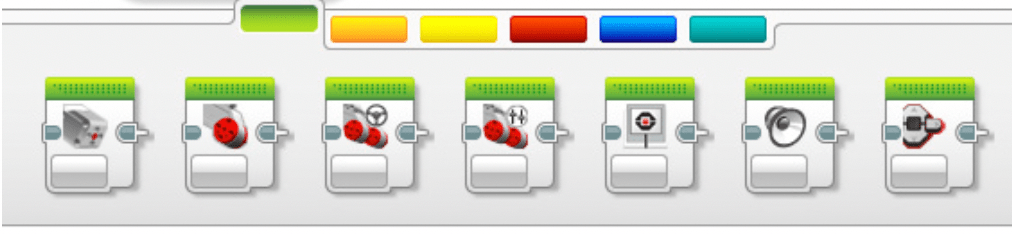
Once the robots are connected to their corresponding laptop and a brief run through of the Action Blocks, students are then free to complete the set task, working collaboratively with guess and check, trial and error and further problem-solving skills. This opportunity for student lead discoveries is why EV3s can be a great tool to enhance creativity.
The major limitations to EV3s as a learning technology in the classroom which need to be considered are the teacher training that may be required on both programming and robotics, as well as the high costs involved. Schools often do not have the funds to purchase EV3 robots and laptops for an entire class to use, and therefore make this learning technology difficult to justify.

References
Henriksen, D., Mishra, P., & Fisser, P. (2016). Infusing creativity and technology in 21st century education: A systemic view for change. Educational Technology & Society, 19(3), 27-37.
Molins-Ruano, Gonzalez-Sacristan, & Garcia-Saura. (2018). Phogo: A low cost, free and “maker” revisit to Logo. Computers in Human Behavior, 80, 428.
Pedaste, M., Mäeots, M., Siiman, L. A., De Jong, T., Van Riesen, S. A., Kamp, E. T., … & Tsourlidaki, E. (2015). Phases of inquiry-based learning: Definitions and the inquiry cycle. Educational research review, 14, 47-61.
 EDUC3620 Digital Creativity and Learning
Hi Isaac,
I agree that when a lesson involving technology is hands-on and collaborative, students will get more out of it. The EV3 Lego Mindstorm sounds like it would be a really good tool for inquiry-based learning as apposed to explicit instruction. This tool sounds like it would foster creativity and a lot of collaborative discussion within the classroom. I like that you mentioned the disadvantage of teachers needing training and that some schools may not have the funds.
Your blog design is also appealing to the eye and easy to read.
LikeLike
Hi Isaac, I enjoyed they way you critically evaluated the benefits of the technology as well as outlining the limitations that teachers may experience using the program. I myself am not very educated in the use of robotics in the classroom so this blog has helped me understand more about its benefits to student learning. I also appreciate that you highlighted the uses of program in inquiry based learning and how its beneficial in facilitating student creativity. I strive to use inquiry based teaching and learning in my classroom and would love to facilitate this for my future students. Looking forward to seeing more from you!
LikeLike
Hi Isaac, it seems like you have a great understanding of how EV3 Lego Mindstorms work and how it could be used as a learning technology to foster students’ creativity. I really agree how learning technologies are best when they are interactive, hands-on, collaborative and gives room for inquiry-based learning! However, for someone who is unfamiliar with robotics, programming or coding, it seems like a lot training and effort would be needed to incorporate it in the classroom. Thank you for explaining the advantages and possibilities of this technology, as well as its limitations!
LikeLike